Enterprise Storage Wallet: A Smarter Way to Store Across India
|
Quick answer: An Enterprise Storage Wallet is a pre-committed block of storage capacity – typically 2,000–10,000 sq. ft. – that a business draws down fractionally across cities instead of signing separate warehouse leases. Store My Goods deploys Wallet capacity across a 75+ city network, with dedicated space starting from ₹100/sq. ft. and custom volume pricing for committed enterprise capacity. One contract, one dashboard, no per-city renegotiation. |
Most companies scaling past two or three cities in India hit the same wall: warehouse leases are fixed, but demand isn’t. You sign a 3,000 sq. ft. lease in Pune for a festive-season spike, and by February you’re paying for empty racks while your Bengaluru fulfilment centre is overflowing.
An Enterprise Storage Wallet solves that mismatch. It’s a single, pre-committed capacity block – say, 3,000 sq. ft. – that you allocate across cities in real time instead of negotiating a separate lease every time demand shifts.
It’s built for D2C brands splitting inventory across metros, 3PLs managing multiple client accounts, retailers absorbing seasonal spikes, and startups that need enterprise-grade warehousing without enterprise-grade capex.
What Is an Enterprise Storage Wallet?
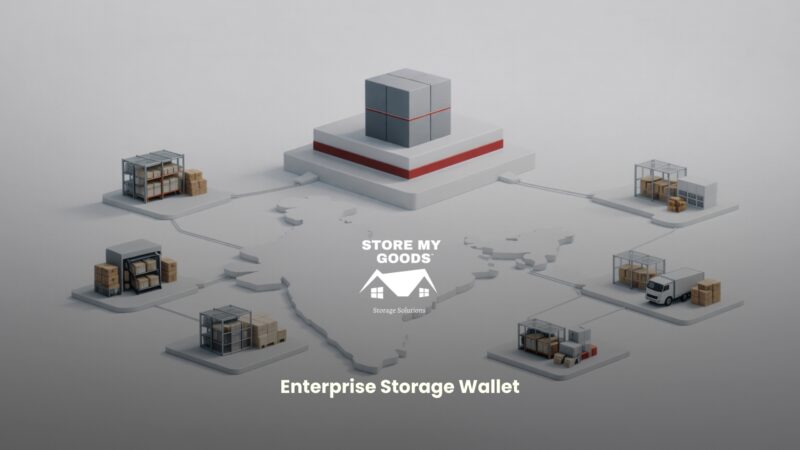
An Enterprise Storage Wallet is a centralised capacity commitment: you agree to a total volume of storage space, and Store My Goods deploys it across our warehouse network wherever your business actually needs it – city by city, month by month.
Think of it as a pan-India storage balance rather than a fixed room. You commit to a number; you draw against it fractionally.
Worked example
A business commits to a 3,000 sq. ft. Enterprise Storage Wallet. In a given month:
• 700 sq. ft. is deployed in Mumbai for e-commerce inventory
• 500 sq. ft. is deployed in Bengaluru for regional fulfilment
• 300 sq. ft. is deployed in Pune for promotional stock ahead of a sale
• The remaining 1,500 sq. ft. sits available for instant allocation the moment a new city or SKU line needs it
No new lease, no fresh paperwork, no 30-day notice period to a new landlord – the capacity already exists on your account; it’s just being pointed at a different city.
How the Enterprise Storage Wallet Works
1. Pre-commit capacity – choose a total sq. ft. volume based on forecasted 6–12 month demand across all cities you operate in.
2. Distribute across warehouses – space is allocated across Store My Goods facilities in Delhi NCR, Mumbai, Pune, Bengaluru, Hyderabad, Noida, and Gurugram, and scales into our wider 75+ city network as needed.
3. Track in real time – one dashboard shows live usage, SKU-level inventory, billing, and fulfilment status per city, so finance and ops are looking at the same numbers.
4. Reallocate on demand – shift capacity between cities monthly or seasonally; most reallocation requests are actioned within 24–48 hours, without a new contract.
For office moves or a renovation that’s freeing up warehouse space in the first place, the same account can also route through packing and moving support so the transition into wallet-based storage doesn’t stall on logistics.
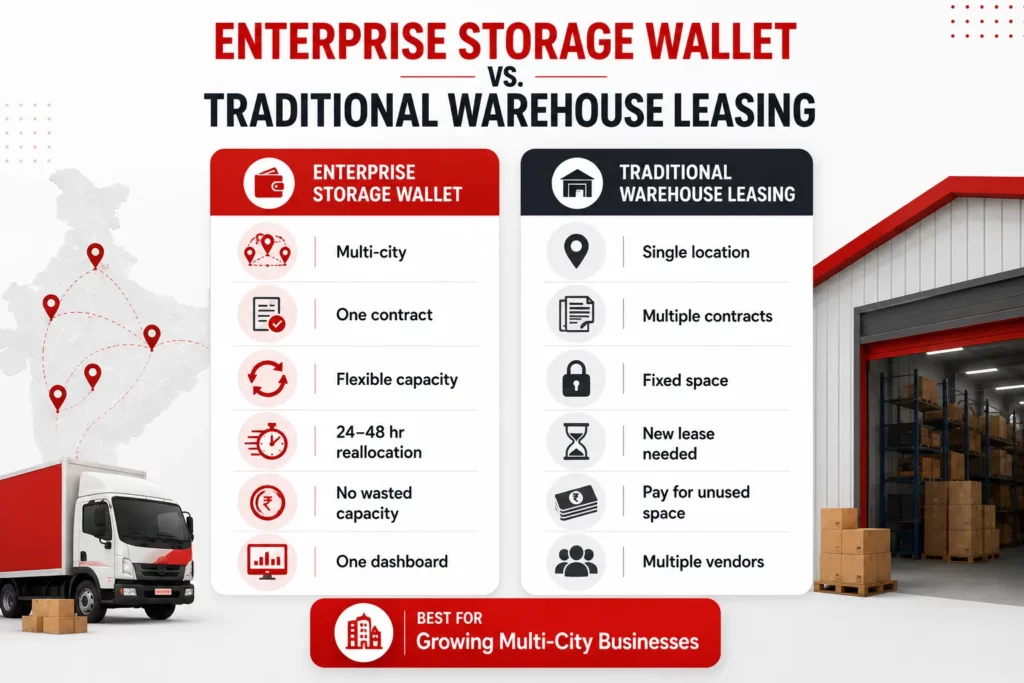
Enterprise Storage Wallet vs. Traditional Warehouse Leasing
A standard warehouse lease in a Tier-1 Indian city typically locks you into a fixed sq. ft. commitment, a 3–5 year term, and a single location – regardless of whether demand in that city holds, grows, or drops.
| Feature | Enterprise Storage Wallet | Traditional Warehouse Lease |
| Capacity model | Single pooled commitment, deployed fractionally across cities | Fixed sq. ft. per location, per lease |
| Contract structure | One contract, one bill, one dashboard for all cities | Separate lease and vendor per city |
| Typical term | Monthly or seasonal reallocation | 3–5 year lock-in, common in Tier-1 markets |
| Reallocating capacity | 24–48 hours between cities, no new contract | New lease negotiation required per city |
| Unused capacity | Carries forward within the Wallet | Sunk cost – paid whether used or not |
| Best for | Multi-city businesses, seasonal demand, D2C/3PL/retail scaling | Single-location, high, stable volume (200+ cu ft) long term |
For businesses testing a new city or running seasonal campaigns, that difference alone can be the gap between a profitable expansion and a warehouse sitting half-empty for two quarters.
Who Should Use an Enterprise Storage Wallet
• D2C & e-commerce brands – split inventory across fulfilment hubs and scale into new cities without negotiating a new lease per launch.
• Retail & FMCG – absorb seasonal demand, hold buffer stock, or support a regional launch without building new infrastructure for a 6-week spike.
• 3PLs & aggregators – manage multiple client accounts against a single wallet, with per-client, per-city usage visible on one dashboard.
• Startups & SMEs – access enterprise-grade warehousing via startup storage without the upfront capex a dedicated facility would demand.
Case in point
A Bengaluru-based D2C skincare brand signed a 2,500 sq. ft. Enterprise Storage Wallet ahead of its first festive season. In October, 1,200 sq. ft. was deployed in Mumbai and Delhi NCR to support flash-sale fulfilment; by January, usage had shifted to 400 sq. ft. concentrated in Bengaluru as seasonal demand normalised. The brand paid for the capacity it used each month, never signed a second lease, and moved its fulfilment footprint three times in four months without a single new vendor conversation.
|
“The businesses that get the most out of a storage wallet are the ones that stopped thinking about warehousing city by city. Once operations and finance can see the same dashboard, capacity stops being a procurement decision and starts being a lever you pull month to month.”
– Storage Operations Lead, Store My Goods | overseeing enterprise deployments across 75+ cities |
Enterprise Storage Wallet Pricing in India
Store My Goods prices Enterprise Storage Wallet capacity off the same plan structure used across our city pages, with volume-based custom quotes for committed capacity:
• Dedicated (private) space – starting from ₹100/sq. ft./month, the base rate a Wallet draws against when a business needs a locked, single-tenant area.
• Shared storage – starting from ₹499/month, relevant for smaller SKU volumes or document/inventory storage bundled into a Wallet.
• Business/Enterprise – custom pricing based on committed sq. ft., number of cities, and contract length; includes a dedicated account manager and enterprise portal access.
Exact per-city rates vary – view live pricing for Mumbai as a reference point, or get a custom Enterprise Storage Wallet quote for your specific city mix and volume.
Why Store My Goods for Your Enterprise Storage Wallet
• Tech-enabled warehouses across Delhi NCR, Mumbai, Pune, Bengaluru, Hyderabad, Noida, and Gurugram, scaling into 75+ cities pan-India
• 7M+ items stored safely, with a 99.2% damage-free record across three-layer, pressure-and-jerk-resistant packaging
• 24/7 CCTV surveillance, biometric access, and fire-detection systems at every facility
• Comprehensive risk coverage included on every item from the moment of pickup
• 4.8★ rating from 3,000+ customers, and featured on Shark Tank India
• One dashboard for usage, billing, SKU-level inventory, and fulfilment status across every city in your Wallet
Explore Business Storage or Warehouse Storage plans, or see coverage in Delhi, Bengaluru, Pune, Hyderabad, and Gurgaon.
Backed by India’s growing warehousing market
This isn’t a niche bet: India’s Grade-A industrial and warehousing stock is on track to reach 45–50 million sq. ft. by the end of 2026, according to a Colliers industry report, while JLL’s warehousing outlook projects urban fulfilment centre space alone to exceed 35 million sq. ft. by 2027 – both trends that favour a flexible, multi-city capacity model over a single fixed lease. A Q1 2026 warehousing market report also shows leasing activity outpacing new supply, which is the exact market condition where locking into one city’s lease terms early becomes a liability rather than a safeguard.
Frequently Asked Questions About Enterprise Storage Wallet
How much does an Enterprise Storage Wallet cost in India?
Pricing is volume-based: dedicated space starts from ₹100/sq. ft./month, and shared storage starts from ₹499/month, with custom quotes for committed enterprise capacity of 2,000+ sq. ft. across multiple cities. Rates vary slightly by city – Mumbai, Delhi NCR, and Bengaluru sit at the higher end of the range. Contact the Store My Goods enterprise team for a quote scoped to your city mix and volume.
What is the minimum capacity commitment for an Enterprise Storage Wallet?
Store My Goods structures Enterprise Storage Wallet plans starting around 2,000 sq. ft. of total pre-committed capacity, deployable across any combination of our 75+ city network. Businesses with lower volume needs are better served by standard Business Storage plans, which don’t require a multi-city commitment.
How quickly can I reallocate storage capacity between cities?
Most reallocation requests – shifting committed sq. ft. from one city to another – are actioned within 24–48 hours once approved through the enterprise dashboard. No new contract or fresh onboarding is required; the capacity already exists on the account.
Is Enterprise Storage Wallet space secure and insured?
Yes. Every facility in the network runs 24/7 CCTV surveillance, biometric access control, and fire-detection systems, and all stored inventory is covered under comprehensive risk coverage from the moment of pickup – the same protection standard applied across Store My Goods’ 7M+ items stored to date.
Can a 3PL manage multiple client accounts under one Enterprise Storage Wallet?
Yes. 3PLs and aggregators can run several client accounts against a single Wallet, with per-client, per-city usage tracked separately on the enterprise dashboard for accurate billing and reporting to each client.
Which cities does the Enterprise Storage Wallet cover?
Core deployment hubs are Delhi NCR, Mumbai, Pune, Bengaluru, Hyderabad, Noida, and Gurugram, with capacity extendable across Store My Goods’ full 75+ city network, including Chennai, Ahmedabad, Coimbatore, and Lucknow, as demand requires.
How is an Enterprise Storage Wallet different from a normal Business Storage plan?
A standard Business Storage plan is scoped to one location. An Enterprise Storage Wallet is a single pre-committed capacity pool deployed across multiple cities under one contract and one dashboard – built for businesses operating in three or more locations rather than one warehouse in one city.
What happens if my business doesn’t use the full committed capacity in a given month?
Unused committed capacity carries forward within the Wallet and remains available for allocation in the following month or a different city – it isn’t forfeited. This is the core difference from a fixed lease, where unused sq. ft. is a sunk cost with no recovery option.
Conclusion
Fixed warehouse leases were built for a slower, single-city version of business growth. An Enterprise Storage Wallet is built for the version most Indian companies are actually living through – demand that shifts between cities month to month, and a need to reallocate capacity faster than a landlord can process a new lease.
Explore Store My Goods’ Enterprise Storage Wallet and Business Storage plans and get a custom quote scoped to your cities and volume in under 2 minutes.
Let’s build your smart storage network – one city at a time.



 A-23, A-Block, Sector 83, Noida Pin Code - 201305
 +91 9311806600
 contact@storemygoods.in
 Hours: 9:30AM - 8:00PM
No Comment