
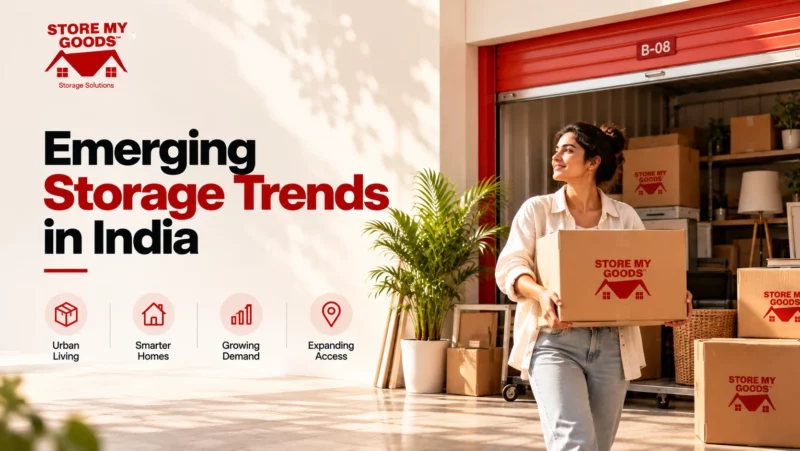
Storage Trends in India: What Modern Consumers Really Want
|
Quick answer: India’s storage market is shifting toward flexible, on-demand and digitally managed storage, and Store My Goods supports this shift with doorstep pickup, professional packing, digital inventory management, secure storage and scheduled retrieval. Instead of committing to a long-term godown lease, customers can use storage for seasonal household items, relocations, extra furniture, business inventory, documents and equipment based on how long and how much space they need. |
India’s storage market has changed shape in the last few years, and the clearest sign is what people have stopped doing: signing year-long godown leases for space they only need for a few months. Smaller apartments, shorter job and lease cycles, and a small-business base that grows in bursts have all pushed demand toward storage you can book online, hand over at your door, and close out when you’re done. Below are the five shifts that matter most for anyone choosing storage in India right now – and what each one should change about the questions you ask a provider.
Trend 1: On-Demand Storage Is Replacing the Long Godown Lease
The old model required committing to a fixed space for a fixed term, usually with a deposit worth several months’ rent. The current model is closer to a subscription: you book the unit size you need, the provider collects from your address, and you extend or close at the end of a billing cycle.
NtMonth-to-month has become the default rather than the exception, with longer 6- and 12-month terms offered as an optional discounted tier. This matters most for the people the old model served worst – students between semesters, professionals between leases, and businesses holding seasonal stock.
If you’re weighing the two, the guide to storage facilities in India covers how the service model actually works end to end, and personal storage with no lock-in periods explains what to check before committing.
Trend 2: Booking, Tracking and Retrieval Have Moved Online
Five years ago, arranging storage meant phone calls and a site visit. Now booking, pickup scheduling and retrieval requests are handled through a website or app, and the physical handover is often the only in-person step. What still varies sharply between providers is inventory visibility: some give you an itemised list of exactly what is stored, others only a unit reference. That difference is invisible at booking and very visible six months later when you want one specific box back.
Ask which you’re getting before you hand anything over – and if you’re ready to compare, you can check availability and book a pickup slot directly.
Trend 3: Climate Control Has Gone From Premium to Baseline
This is the trend most driven by physical reality rather than preference. Indian monsoon humidity and summer heat damage wooden furniture, electronics, paper documents, photographs and fabric over months rather than years, and enough customers learned that the hard way for climate control to become a screening criterion rather than an upsell. CCTV coverage and pest management have followed the same path.
For non-perishable items – tools, metal shelving, construction material – it genuinely matters less, so you shouldn’t pay for it where it adds nothing. The categories where it is non-negotiable are electronics and appliances, wooden furniture, and business documents. For anything going away for a long stretch, the long-term storage checklist is worth running through first.
Trend 4: Storage Is Being Bought for Lifestyle, Not Just Crisis
The older pattern was reactive – people rented storage during a move or a renovation and closed it as soon as the disruption ended. The newer pattern is planned and recurring, and it splits cleanly into two groups.
Households: Seasonal, Festive and Hobby Storage
Festival decorations that sit unused for eleven months, winter clothing in cities that barely have a winter, and sports or hobby equipment that’s bulky relative to how often it’s used – these are now common year-round bookings rather than emergency ones.
Practical starting points: festival storage and when to access it, storing winter clothing, and sports equipment storage.
Businesses: Overflow Stock, Documents and Equipment
On the business side, storage has become a way to avoid leasing more square footage than daily operations justify – overflow inventory, archived paperwork, marketing material, and equipment between projects. Startups and SMEs use it to scale space in step with revenue instead of ahead of it.
See business storage and warehouse storage for the service side, and storage mistakes businesses should avoid for the errors that come up most often.
Trend 5: Renting Space Beats Renting a Bigger Home or Office
The underlying calculation is simple: in metros where residential and commercial rent is the dominant cost, holding rarely-used goods in prime space is the most expensive possible option. Renting storage separately unbundles that – you pay housing rates for space you live in and storage rates for space you only need to hold things.
Unit sizes now scale in tiers, so a household between homes and a business holding overflow stock aren’t forced into the same footprint. Getting the tier right is the part people most often get wrong; the storage unit size guide walks through sizing by room count and stock volume before you book.
| The biggest shift in storage is no longer just about renting extra space – it is about making storage easier to use. Before choosing a provider, check how booking, pickup, inventory tracking and retrieval work, along with insurance and minimum-term requirements. For businesses, also confirm how quickly individual items or stock can be retrieved. A flexible storage service should reduce the effort of managing your belongings, not simply provide another place to keep them. – Store My Goods Storage Operations Team |
How These Trends Differ Across Indian Metros
Storage demand in India isn’t uniform, and a national average hides that. In Mumbai, the pressure is pure square footage – per-square-foot housing costs make an extra room the most expensive way to hold seasonal items, so household demand skews toward furniture and long-term overflow.
In Bengaluru and Pune, the pattern follows a transient professional population: shorter bookings clustered around job changes and lease cycles, often a single room’s worth of belongings. Delhi NCR, including Noida and Gurgaon, shows the most mixed demand – household storage from dense residential sectors alongside business storage from nearby industrial and startup clusters, which is why the same facility often serves both.
Hyderabad and Chennai came to the category later and are growing from a smaller base, with business and document storage forming a larger share of early demand. The practical implication: ask whether the operator runs facilities in your city or sub-contracts locally, because retrieval speed and handling standards follow whoever physically holds the goods.
Frequently Asked Questions About Storage Trends in India
Q: What is driving the growth of self storage in India?
A: Four things, mostly structural: apartment sizes shrinking in metros while household goods haven’t, more people changing homes and jobs on shorter cycles, small businesses needing overflow space without a long lease, and doorstep pickup removing the logistics burden that used to make storage impractical. The common thread is flexibility – demand shifted once storage stopped requiring a year-long commitment.
Q: How is self storage different from renting a godown in India?
A: A godown is a property lease: multi-year term, a deposit often worth several months’ rent, and security you arrange yourself. Self storage is a managed service – the operator handles pickup, monitoring, climate control and retrieval, and you rent only the unit size you need, month to month. The trade-off is that you don’t get unrestricted walk-in access to your own space; retrieval is scheduled.
Q: Is climate-controlled storage actually necessary in India?
A: For most of the country, yes, for anything sensitive. Monsoon humidity and summer heat damage wooden furniture, electronics, documents, photographs and fabric over a matter of months, not years. For purely non-perishable items – metal shelving, tools, construction material – it matters far less. The reason it is now near-standard rather than a premium extra is that the damage cases were predictable enough to become a service expectation.
Q: Which Indian cities have the most self-storage demand?
A: Mumbai and Delhi NCR (including Noida and Gurgaon) lead on volume, driven by housing density and a large business base. Bengaluru and Pune follow, with demand shaped by a transient professional population and shorter booking cycles. Hyderabad and Chennai are growing from a smaller base, with business and document storage forming a larger share of early demand.
Q: Can I book and manage storage entirely online now?
A: Largely, yes – that is one of the clearest shifts in the category. Booking, scheduling a pickup slot, and requesting retrieval are typically handled through a website or app, with the physical handover being the only in-person step. What still varies between providers is inventory visibility: whether you can see an itemised list of what is stored, or only a unit reference.
Q: Is storage in India safe for valuable or fragile items?
A: At a well-run facility, yes – CCTV monitoring, climate control and pest management are now baseline. The variable is insurance, not security: confirm the per-item claim ceiling in writing and whether cover is automatic or opt-in, since a flat-rate policy under-protects high-value goods. For fragile items, also ask how they are packed and whether the operator handles packing or expects you to.
Q: What should businesses look for that households don’t need to?
A: Two things: documented inventory on intake, and a stated retrieval SLA. A household storing off-season furniture can wait 48 hours; a business pulling stock mid-week cannot. If a provider can’t confirm a same-day or next-day retrieval window and can’t show how items are catalogued, the facility is built for archival storage rather than operational use.
Q: Are there minimum lock-in periods for storage in India?
A: Increasingly, no – month-to-month has become the default, and the move away from mandatory lock-ins is itself one of the bigger recent shifts. Longer commitments are usually offered as an optional discounted tier rather than a requirement. It’s still worth confirming the notice period for closing a unit, which varies between providers even when there’s no lock-in.
Related Reading
- How Storage Works in India: A Beginner’s Guide
- What Size Storage Unit Do You Really Need?
- Safe Storage in India: What It Means and What It Costs
- Self-Storage Facilities in India: Nearby, Smart and Safe
- Global Trends in Self Storage – the industry-side view; cross-link back from that post to this one to keep the two clearly separated.

 A-23, A-Block, Sector 83, Noida Pin Code - 201305
 +91 9311806600
 contact@storemygoods.in
 Hours: 9:30AM - 8:00PM
No Comment