
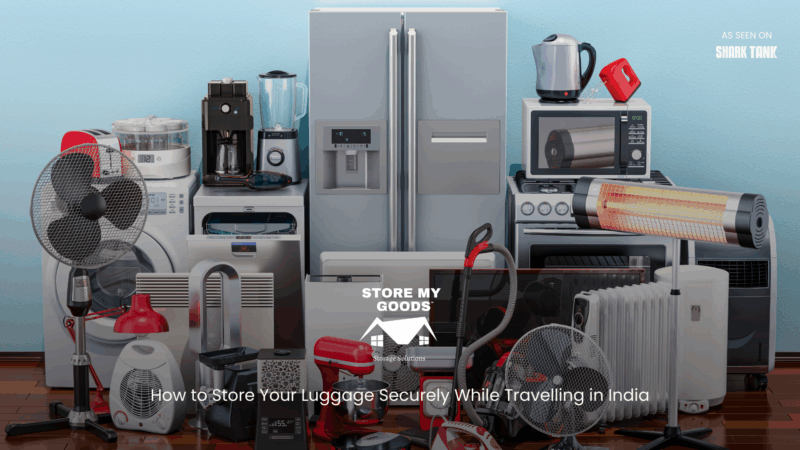
Electronic Appliance Storage Hacks for Moving & Renovating in India
|
Quick Answer: To store electronic appliances safely during moving or renovation: 1) Defrost refrigerators 48 hours prior and leave doors propped open to prevent black mold; 2) Drain washing machine pumps and drums completely to stop standing-water bacteria; 3) Keep OLED/Smart TVs strictly vertical in double-walled boxes with anti-static foam; 4) Use climate-controlled, dust-sealed storage with relative humidity below 55% to protect sensitive printed circuit boards (PCBs). Store My Goods offers tech-enabled, insured appliance storage starting at ₹499/month for shared units and ₹100/sq. ft. for dedicated private space across 75+ Indian cities. |
Household electronic appliances-from double-door frost-free refrigerators, inverter washing machines, and 65-inch OLED televisions to microwave ovens and split air conditioners-represent some of the largest financial investments in any Indian home. Yet, during house shifting or deep home renovation, these high-value devices are routinely exposed to accidental drops, abrasive construction debris, and severe humidity damage.
Unlike sturdy wooden tables or metal beds, modern appliances are packed with sensitive printed circuit boards (PCBs), refrigerant compressors, liquid crystal displays, and rubber gaskets. A single drop of trapped water inside a stored washing machine drum can spawn mold within 72 hours, while masonry silica dust from tile demolition can permanently short-circuit inverter motherboards.
Whether you are relocating across cities with professional packing and moving services or temporarily moving furniture into electronic appliance storage in India, this comprehensive guide provides the exact scientific hacks to keep your appliances running like new.
Appliance-by-Appliance Deep Dive: Preparation & Storage Protocols
1. Refrigerators & Deep Freezers: The 48-Hour Defrost Rule Never unplug a refrigerator the morning of moving. Unplug the unit at least 48 hours prior to allow internal coils to melt completely. Empty the drain pan at the back of the compressor, disconnect water dispenser lines, and clean internal shelves with a dilute vinegar solution to kill odor-causing bacteria. Most importantly: tape the doors slightly ajar during storage using a rolled cardboard wedge to allow airflow and prevent black mold.
2. Washing Machines & Dishwashers: Purging Hidden Reservoirs Washing machines hold up to 2 liters of stagnant water inside drain pumps, coin traps, and internal hoses even after a spin cycle. Disconnect the water supply hoses, run a short ‘spin-only’ drain cycle, unscrew the lower lint filter to drain lingering water, and prop the door open for 24 hours. For front-load machines, install transit bolts (shipping bolts) into the back chassis to lock the heavy suspension drum and prevent motor damage during transit.
3. OLED, QLED & Smart TVs: The Strict Vertical Stance Never transport or store flat-screen televisions horizontally. Laying an OLED screen flat places severe pressure on the center of the thin glass substrate. Wrap the display in anti-static PE foam sheet first (standard bubble wrap can generate electrostatic discharge), fit high-density EPS corner protectors, and slide the TV vertically into a heavy-duty double-walled telescopic carton. Label both sides with ‘UP’ arrows and ‘Fragile Glass’.
4. Split Air Conditioners: Refrigerant Pump-Down & Coil Sealing Hire a licensed HVAC technician to execute a proper ‘refrigerant pump-down’ so the freon/R32 gas is compressed back into the outdoor compressor unit before uncoupling copper piping. Crimp and tape copper tube ends to prevent moisture and dust from entering the sealed cooling loop. Clean the indoor filter mesh thoroughly and store indoor and outdoor units upright in bubble wrap and corrugated cardboard.
5. Microwave Ovens, Air Fryers & Countertop Gadgets Remove the glass turntable plate and roller ring from the microwave, wrap them in bubble wrap separately, and pack them inside the microwave cavity with clean paper padding. Deep-clean grease from air fryers and toaster ovens, as oil residue attracts pests and turns rancid during storage. Coil power cords neatly with reusable velcro ties.
Electronic Appliance Storage & Packaging Matrix
| Appliance Type | Vulnerability Risk | Mandatory Prep Action | Storage Staging Rule |
| Refrigerator / Freezer | Black mold growth, gasket decay, compressor oil shift | Defrost 48 hrs prior; clean with vinegar; drain drip pan | Keep strictly upright; prop doors open 1-2 inches. |
| Front-Load Washer | Drum suspension misalignment, stagnant water odor | Install rear transit locking bolts; empty coin trap pump | Store on flat wooden pallet; door slightly ajar. |
| OLED / QLED Smart TV | Micro-fractured display glass, electrostatic discharge | Wrap in anti-static PE foam; pack in vertical crate | Never lay flat; secure against flat truck side rail. |
| Split Air Conditioner | Refrigerant leak, copper tube oxidation, moisture inside coils | Professional pump-down; seal copper ends with brass caps | Keep outdoor compressor upright on rubber dampers. |
| Microwave & Air Fryer | Shattered turntable glass, rancid grease odors | Remove glass plate; wrap separately; deep clean grease | Stack on middle storage tier inside 5-ply cartons. |
Climate-Controlled vs. Standard Storage: Humidity Science for Electronics
In high-humidity coastal and river-basin Indian metros like Mumbai, Chennai, and Kolkata, relative humidity (RH) frequently exceeds 80% during monsoon and post-monsoon months. When appliances sit in non-climate-controlled tin sheds or basements, ambient moisture condenses onto cold metallic solder joints on printed circuit boards.
This condensation triggers galvanic corrosion and dendritic tin whiskering, creating short circuits the moment you plug your TV or inverter washing machine back into the wall. Store My Goods climate-controlled facilities regulate indoor humidity levels below 55% RH and maintain dust-free, pest-controlled air filtration, preventing electrochemical corrosion and rubber seal degradation.
DIY Appliance Storage vs. Store My Goods Managed Service
| Comparison Factor | DIY Home Storage (Covered with Sheets) | Store My Goods Managed Facility |
| Renovation Dust Protection | Low: Microscopic cement/silica dust penetrates vents and fans. | 100% Dust-Proof: 3-layer sealed packaging off-site in clean warehouse. |
| Moisture & Mold Risk | High: Trapped moisture causes black mold in gaskets and rust on coils. | Zero: Regulated ventilation and silica desiccant pouches. |
| Transit & Lifting Labor | Exhausting: Heavy lifting risks personal injury and dropped items. | Doorstep logistics: Trained moving crew handles dismantling and lifting. |
| Cost & Flexibility | Keeping extra rooms or repairing broken appliances costs ₹15,000–₹40,000. | Starting at ₹499/month (Shared) or ₹100/sq. ft. (Private) with full insurance. |
How Store My Goods Doorstep Appliance Storage Works
1. Book Your Storage Volume Online: Select your appliance count and duration on Store My Goods in under 2 minutes.
2. Doorstep Professional 3-Layer Packing: Our technicians arrive with anti-static foam, bubble wrap, corrugated sheets, and transit strapping to pack your appliances safely.
3. Secure, Climate-Monitored Warehousing: Stored in clean, 24/7 CCTV-monitored facilities across 75+ cities including Mumbai, Delhi NCR, Bangalore, Pune, and Hyderabad.
4. Prompt Redelivery & Placement: Once your new home or renovation is ready, request redelivery via your digital dashboard; our crew delivers and unpacks your appliances on-site.
Frequently Asked Questions About Electronic Appliance Storage
Q1: Can I store a refrigerator on its side during transport or storage?
No, never store a refrigerator on its side. Doing so causes compressor lubricating oil to flow into the cooling refrigerant tubes. If turned on later, the compressor can suffer fatal oil starvation and seize. Always store upright, and if tilted during moving, let it stand upright for 24 hours before plugging in.
Q2: How do I prevent mold from growing inside a stored washing machine or fridge?
Completely drain all residual water from pump filters and hoses. Clean interiors with a 50/50 water-vinegar wipe, and leave doors propped slightly open (1–2 inches) using tape and a cardboard wedge to maintain continuous airflow.
Q3: Should I remove batteries and power cables before storing electronic devices?
Yes. Always remove alkaline batteries from remotes, smart thermostats, and clocks, as batteries leak corrosive acid over time. Detach power cables, label them with painter’s tape, and place them in zip-lock bags taped to the parent device.
Q4: How do I protect smart TVs from static electricity during packing?
Use anti-static polyethylene (PE) foam rolls as the initial contact layer. Standard plastic bubble wrap generates static electrical charges that can damage delicate LCD/OLED driving transistors.
Q5: How much does appliance storage cost per month with Store My Goods?
Store My Goods offers shared storage starting from ₹499/month and dedicated private lockable storage from ₹100/sq. ft, with professional doorstep packing, pickup, and comprehensive insurance coverage.
Q6: Can I retrieve just my microwave or laptop while other large appliances stay in storage?
Yes! Every item is assigned a digital QR code and catalogued in your personal online inventory. You can request partial retrieval of any individual item at any time.
Q7: Are stored electronics protected against transit and warehouse damages?
Yes. Store My Goods maintains a verified 99.2% damage-free safety record and provides comprehensive transit and warehouse risk coverage across all stored goods.




 A-23, A-Block, Sector 83, Noida Pin Code - 201305
 +91 9311806600
 contact@storemygoods.in
 Hours: 9:30AM - 8:00PM
No Comment