
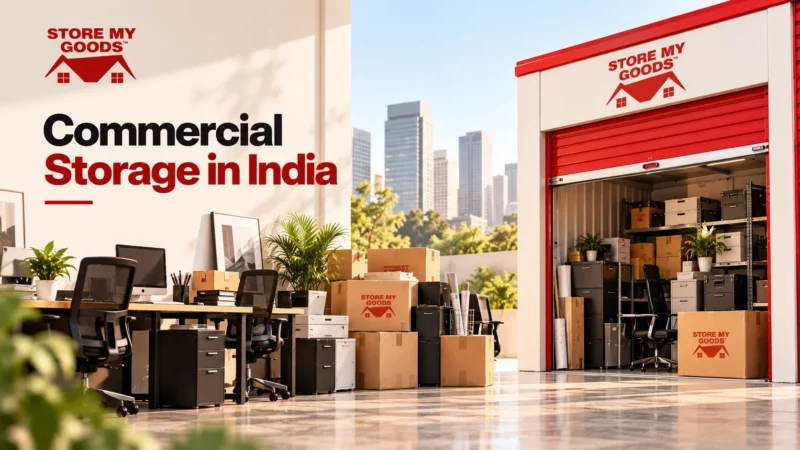
Commercial Storage in India: The Hidden Secret to Business Success
|
Quick answer: Commercial storage moves inventory, documents, and equipment off premium office or retail space and into a dedicated, flexible facility, cutting real estate costs without cutting capacity. It suits retailers managing seasonal stock, manufacturers storing raw materials near distribution hubs, and SMEs that need room to grow without signing a multi-year lease. See the full breakdown by business type below, or get a storage quote in under 2 minutes. |
Running a business in India increasingly means paying more for the square footage it sits on. Average office rentals across the country’s top 7 cities rose 6% year-on-year to roughly ₹90 per sq ft per month in the first nine months of 2025, according to ANAROCK research reported by IANS. Every carton of inventory or filing cabinet sitting on that floor is quietly costing far more than it needs to.
What Commercial Storage Actually Is?
Commercial storage gives businesses dedicated, professional space for inventory, documents, equipment, or seasonal stock, separate from office or retail premises. Unlike a spare room or a corner of a warehouse, these facilities are purpose-built: organised, monitored, and designed for goods to be retrieved on demand rather than dug out from storage that’s really just an afterthought.
Why It’s a Cost and Efficiency Lever, Not Just Extra Space
- Cost savings: paying for storage-grade space costs a fraction of premium office or retail rent for the same square footage.
- Flexibility: space scales up for a busy season and back down afterward, unlike a fixed lease.
- Security: CCTV, climate control, pest management, and insurance protect goods an office backroom typically can’t.
- Operational focus: teams work in a clutter-free space instead of navigating around stacked inventory.
Who Actually Uses Commercial Storage in India
| Business Type | What They Store | Why It Matters |
| Retailers & e-commerce | Peak-season stock, returns, overflow inventory | Avoids overcrowding retail or office floor space |
| Manufacturers | Raw materials, finished goods near distribution hubs | Cuts last-mile delivery time and warehousing cost |
| Event companies | Exhibition props, banners, stage setups | Keeps gear safe and ready between events, not renting a permanent unit |
| SMEs & startups | Files, equipment, early inventory | Delays the cost of a bigger office until it’s actually needed |
| Restaurants & FMCG | Equipment, signage, stock during a move or closure | Bridges the gap without abandoning usable assets |
Startups and SMEs in particular benefit from delaying a larger office lease; startup storage plans let a small team keep growing without a five-year real estate commitment attached to it. For paperwork specifically, dedicated document storage keeps compliance records and archives organised and retrievable without eating into working office space.
| “The businesses that get this right treat storage as a lever, not a leftover. They’re not asking ‘where do we dump this,’ they’re asking ‘what’s the cheapest square foot we can put this on.’ That’s usually not the office they’re paying premium rent for.” – Arjun Mehta, Storage Operations Head, Store My Goods |
Commercial Storage vs. Traditional Warehouse Lease
A conventional warehouse lease typically runs 3-10 years with a large upfront deposit, built for businesses with stable, high-volume, long-term needs. Commercial storage is the better fit for businesses that need flexibility: seasonal retailers, growing SMEs, or companies testing a new city before committing. For consistently high-volume operations, a dedicated warehouse storage arrangement negotiated directly may work out cheaper per square foot over the long run.
Frequently Asked Questions About Commercial Storage
How much does commercial storage cost in India?
Commercial storage pricing depends on volume, city, and whether it’s shared or dedicated space. Confirm current per-sq-ft and per-pallet rates at storemygoods.com. It’s typically a fraction of prime office or retail rent for the same square footage.
What is the difference between commercial storage and a warehouse lease?
A warehouse lease is a long-term commitment, often 3–10 years, for a fixed amount of space. Commercial storage is flexible and scalable month-to-month, suited to businesses that don’t yet know how much space they’ll need a year from now.
Can a small business or startup use commercial storage?
Yes. Commercial storage is often more accessible to SMEs and startups than a warehouse lease, since it doesn’t require a large deposit or multi-year commitment, and space can be added or reduced as the business grows.
Is commercial storage secure enough for high-value inventory?
Reputable commercial storage facilities include 24/7 CCTV, access control, climate control, and pest management, along with insurance cover, protections most office backrooms or rented garages don’t offer.
Does commercial storage include pickup and delivery?
Most tech-enabled commercial storage providers include doorstep pickup and delivery, so a business’s own team or vehicles don’t need to handle transport and loading.
Can I track exactly what’s stored in commercial storage?
Yes. Digital inventory dashboards let businesses see what’s stored, request specific pallets or cartons, and track retrieval status without a physical visit to the facility.
Conclusion
Every square foot of premium office or retail space used for storage is a square foot not used for revenue-generating work. As commercial rents keep climbing across India’s major cities, moving inventory, files, and equipment into dedicated commercial storage isn’t a workaround, it’s a straightforward cost decision.
Explore business storage plans or get a free quote in under 2 minutes.


 A-23, A-Block, Sector 83, Noida Pin Code - 201305
 +91 9311806600
 contact@storemygoods.in
 Hours: 9:30AM - 8:00PM
No Comment