
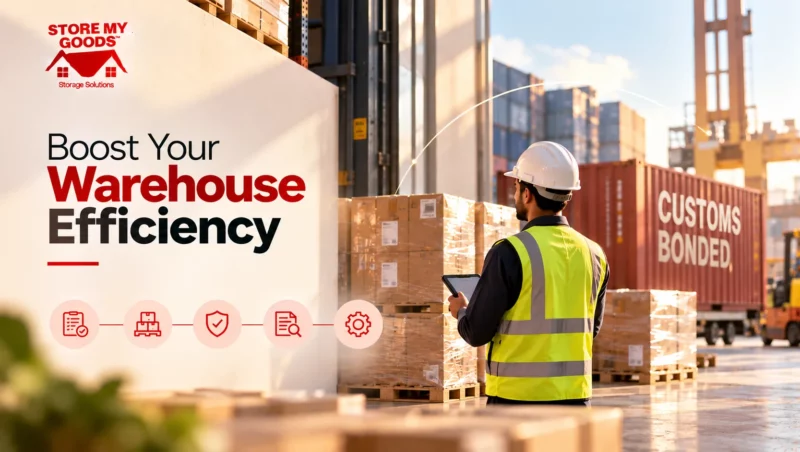
Boost Your Warehouse Efficiency: 5 Steps for Customs Bonded Operations
|
Quick Answer: A customs bonded warehouse is a licensed facility where imported goods can be stored, processed, or manufactured without paying customs duty until they are released into the domestic market or re-exported. Businesses boost bonded warehouse efficiency by deploying real-time WMS barcode tracking, optimizing vertical racking layouts, automating CBIC/ICEGATE compliance filing, enforcing 24/7 biometric security, and partnering with 3PL providers like Store My Goods. |
In today’s fast-paced global supply chain, operational efficiency and capital liquidity dictate market competitiveness. For Indian importers, exporters, e-commerce brands, and manufacturing enterprises, managing cross-border logistics involves navigating complex customs tariffs and strict regulatory compliance. This is where customs bonded warehouses play a pivotal role. Governed by the Central Board of Indirect Taxes and Customs (CBIC) under Section 59 of the Indian Customs Act 1962, bonded facilities allow businesses to defer import duties until goods enter domestic consumption.
By deploying strategic warehousing practices, enterprise supply chains can unlock millions in deferred working capital while maintaining seamless order fulfillment across major Indian commercial hubs like Mumbai, Delhi NCR, and Bangalore. This comprehensive guide breaks down the legal framework, cost-benefit ROI, 5 operational efficiency steps, technology stack, and compliance checklists for modern bonded operations.
Customs Bonded vs. Non-Bonded Warehouses: Strategic Comparison
| Comparison Feature | Customs Bonded Warehouse | Standard Non-Bonded Warehouse |
| Duty Payment Timing | Deferred until goods leave warehouse for domestic sale or completely waived if re-exported. | Paid upfront immediately upon port arrival before warehouse entry. |
| Working Capital Impact | High liquidity – cash is retained until sales revenue is realized. | Low liquidity – substantial cash blocked in upfront import taxes. |
| Re-Export Flexibility | Seamless duty-free re-exporting to international markets. | Duty refund (Duty Drawback) requires lengthy administrative processes. |
| Customs Oversight & Security | Strict CBIC licensing, 24/7 CCTV, double-lock control, and ICEGATE digital tracking. | Standard commercial security without direct customs officer supervision. |
| Ideal Business Model | Importers, raw material processors, high-value electronics, e-commerce hub distribution. | Domestic distribution, local finished goods storage, fast-moving FMCG. |
5 Actionable Steps to Boost Bonded Warehouse Efficiency
Step 1: Deploy Real-Time WMS & Digital Barcode Scanning: Manual ledger logging is the single largest bottleneck in customs bonded facilities. Implementing a Cloud-based Warehouse Management System (WMS) with barcode and RFID scanning ensures real-time inventory tracking. Every incoming container is scanned, logged against its Into-Bond Bill of Entry, and allocated a specific bin location, cutting put-away errors by 98%.
Step 2: Optimize Racking Layout & ABC Velocity Slotting: Maximize vertical cube space by installing high-density selective pallet racking and VNA (Very Narrow Aisle) systems. Utilizing ABC inventory velocity analysis places fast-moving SKUs (Category A) near staging docks, reducing forklift travel time and speeding up Ex-Bond dispatch cycles.
Step 3: Automate Customs Documentation via ICEGATE Sync: Delays in filing Ex-Bond Bills of Entry or re-export shipping bills trigger severe demurrage and port storage fees. Direct API integration between your WMS and India’s ICEGATE portal automates document verification, ensuring instant duty calculation and automated clearance certificates.
Step 4: Implement Biometric Security & Climate-Controlled Risk Protection: Bonded warehouses must comply with stringent physical and environmental security regulations. Deploying 24/7 CCTV coverage, biometric access gates, automated fire suppression systems, and IoT temperature/humidity sensors safeguards high-value bonded inventory against damage and unauthorized access.
Step 5: Partner with Experienced 3PL Managed Warehousing Providers: Setting up a private bonded facility requires significant capital investment and lengthy licensing procedures. Partnering with a professional 3PL logistics provider like Store My Goods business storage gives your enterprise immediate access to compliant, tech-enabled warehouse storage in Mumbai, Delhi NCR, and Bangalore with zero upfront capital expenditure.
Financial ROI: Duty Deferment & Working Capital Optimization
To understand the direct financial impact of bonded warehouse operations, consider an enterprise importing electronics components valued at ₹10 Crore ($1.2 Million) per year. Below is the financial breakdown comparing immediate duty clearance vs bonded warehousing deferment:
| Financial Metric | Immediate Customs Clearance | Customs Bonded Warehouse Deferment |
| Imported Goods Value | ₹10,000,000 (₹10 Crore) | ₹10,000,000 (₹10 Crore) |
| Upfront Duty Paid at Port (28%) | ₹2,800,000 (₹2.8 Crore) Paid Immediately | ₹0 Paid at Port (100% Deferred) |
| Average Holding Period | 6 Months in Domestic Stock | 6 Months in Bonded Facility |
| Interest Saved on Capital (10% p.a.) | ₹0 (Capital Blocked) | ₹1,400,000 (₹14 Lakhs Direct Interest Savings) |
Step-by-Step Customs Bonded Operations Checklist for Importers
1. Pre-Arrival & Into-Bond Filing: File Into-Bond Bill of Entry (Form Thrice) on ICEGATE prior to vessel arrival.
2. Execution of Bond & Guarantee: Execute a triple-duty bond under Section 59 with bank guarantee or security.
3. Inspection & Escort Transport: Customs officer inspects seals; goods are transported via licensed GPS-tracked container trucks to the bonded warehouse.
4. Warehouse Receiving & WMS Entry: Goods are unpacked, verified against packing lists, assigned QR/barcode tags, and placed in assigned pallet racks.
5. Ex-Bond Clearance / Domestic Dispatch: When sales occur, file Ex-Bond Bill of Entry, pay applicable duty for released SKU quantity, obtain out-of-charge order, and dispatch.
Frequently Asked Questions About Customs Bonded Warehousing
Q1: What is a customs bonded warehouse, and how does it work under Indian Customs Law?
A customs bonded warehouse is a secured, CBIC-licensed facility where imported goods can be stored, processed, or manufactured without paying immediate import duties. Under Section 59 of the Indian Customs Act 1962, customs duty payment is deferred until goods are cleared for domestic consumption. If the goods are re-exported to international markets, import duties are 100% legally waived.
Q2: What is the maximum duration imported goods can stay in a customs bonded warehouse in India?
Under Section 61 of the Indian Customs Act, capital goods and machinery imported under schemes like MOOWR can remain in a bonded warehouse for up to 5 years (or until manufacturing operations conclude). Non-capital commercial goods can be stored for up to 1 year, which can be extended further by the Commissioner of Customs upon official request.
Q3: What is the difference between the MOOWR scheme and traditional bonded warehousing?
Traditional bonded warehousing (Sections 57 & 58) primarily focuses on storing imported goods to defer duty until domestic release. The Manufacture and Other Operations in Warehouse Regulations (MOOWR) scheme allows importers to conduct manufacturing, assembly, value addition, and processing directly inside the warehouse with zero upfront Basic Customs Duty (BCD) or IGST, making it ideal for export manufacturers and tech assembly units.
Q4: How does a customs bonded warehouse improve business cash flow and working capital?
Bonded warehousing eliminates upfront customs duty payments at the port of entry (which typically range from 18% to 28% in combined BCD + IGST). By deferring tax payments until sales occur and goods are released into the domestic market, businesses retain operational cash flow, eliminate working capital financing costs, and match duty payouts directly with revenue realization.
Q5: Can goods stored in a customs bonded warehouse be re-exported without paying import duty?
Yes. If imported goods, components, or raw materials stored in a customs bonded warehouse are re-exported directly to international destinations without entering the domestic tariff area, 100% of the customs duty is legally waived. This avoids lengthy administrative delays associated with traditional Duty Drawback refund claims.
Q6: What technology is required to manage a modern customs bonded warehouse efficiently?
An efficient bonded warehouse requires a Cloud-based Warehouse Management System (WMS) integrated directly with India’s ICEGATE portal via EDI/API connections. Essential technologies include barcode and RFID item-level scanning for automated Into-Bond and Ex-Bond logging, IoT temperature sensors for climate-sensitive cargo, and 24/7 biometric access control with AI CCTV surveillance meeting CBIC compliance standards.
Q7: How does Store My Goods assist businesses with warehouse storage and logistics in India?
Store My Goods provides flexible, tech-enabled business and warehouse storage across 75+ Indian cities – including Mumbai, Delhi NCR, Bangalore, Pune, and Hyderabad. Key features include 24/7 CCTV surveillance, digital WMS inventory tracking, 3-layer protective packaging, doorstep pickup and delivery, and scalable dedicated space options starting from ₹100/sq. ft.
Conclusion:
Boosting efficiency in a customs bonded warehouse requires a mix of smart planning, technology, and compliance. By streamlining inventory, optimizing layout, training staff, automating processes, and collaborating with customs authorities, you can cut costs, reduce delays, and stay ahead in global trade. Improve your supply chain efficiency with Store My Goods warehouse solutions, including customs bonded operations tailored for your business.



 A-23, A-Block, Sector 83, Noida Pin Code - 201305
 +91 9311806600
 contact@storemygoods.in
 Hours: 9:30AM - 8:00PM
No Comment