
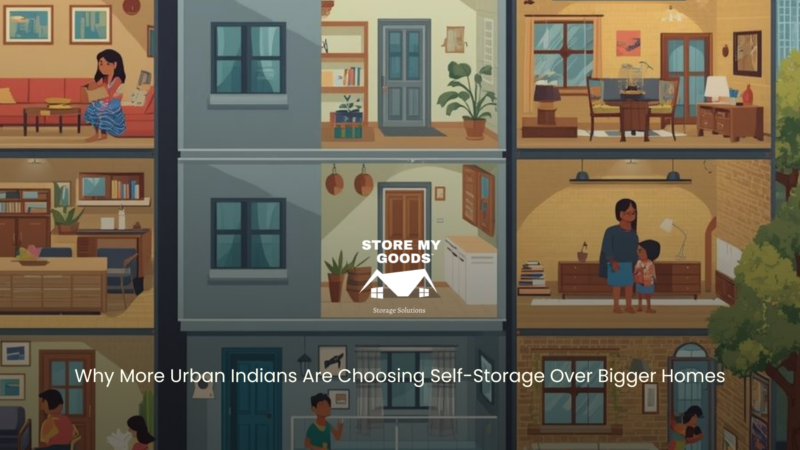
Why More Urban Indians Are Choosing Self-Storage Over Bigger Homes
|
Quick answer: Self-storage typically costs a fraction of what an extra room does. Store My Goods’ shared storage starts from ₹499/month and private, dedicated space from ₹100/sq. ft. – against ₹4,000–₹15,000/month in maintenance alone for a larger Mumbai apartment, before the higher rent or EMI is even counted. With doorstep pickup, digital tracking, and no lock-in, it’s the cheaper way to solve a space problem without moving. |
In India’s biggest cities, living space comes at a premium. Homebuyers and renters in Mumbai, Delhi, Bengaluru, Hyderabad, Pune, and Noida are dealing with rising real estate prices and shrinking apartment sizes at the same time. Bengaluru’s average residential price rose roughly 24% year-on-year in Q1 2026 – the sharpest jump among India’s top eight cities – with Delhi-NCR and Mumbai not far behind. Every extra square foot costs more each year, and upgrading to a bigger flat means stretching a budget that was already tight.
Yet families keep growing and belongings keep accumulating. Rather than draining savings on a larger home, a growing number of urban Indians are choosing self-storage instead – and the math behind that choice is more concrete than most people realise.
The High Cost of Space in Urban India
Real estate inflation isn’t the only deterrent to upsizing one’s home. Even if someone can afford a larger flat, the ongoing maintenance and upkeep costs are substantial. Monthly society maintenance fees in big-city apartment complexes can range widely (roughly ₹2 to ₹25 per sq ft), which translates to thousands of rupees every month just for upkeep.
In Mumbai, a typical apartment owner might pay ₹4,000–₹15,000 per month in maintenance charges – a hefty add-on to any mortgage or rent. Bigger homes also mean higher utilities, more cleaning, and greater responsibilities for the homeowner. Busy professionals and young families often prefer to avoid these burdens. Additionally, there’s a shifting mindset toward minimalist living. With compact homes becoming the norm in city life, many people aim to “do more with less” – reducing clutter and owning only what they truly need day-to-day. A larger flat full of seldom-used stuff no longer appeals to those who prize simplicity and financial prudence.
Self-Storage vs. Renting a Bigger Home: The Real Cost
Run the numbers side by side and the case for storage over square footage gets a lot more concrete:
| Cost factor | Bigger flat (extra room) | Self-storage |
| Monthly cost | ₹4,000–₹15,000 maintenance alone (Mumbai), before higher rent/EMI | ₹499–₹2,000/month depending on volume |
| Commitment | New lease or purchase, typically 11-month+ rental agreements | No lock-in – month to month |
| Access to items | Immediate, but items sit unused most of the year | Request specific boxes back in 24–48 hours |
| Setup effort | Moving, brokerage fees, deposit, furnishing | Doorstep pickup, packed and catalogued for you |
| Insurance | Usually purchased separately | Included in every plan |
| Best for | Permanent extra living/working space needs | Seasonal items, overflow, renovation, relocation, downsizing |
For most households storing under 15–20 boxes’ worth of overflow, self-storage costs a fraction of what carrying an extra room does – and it’s the only option in the table with no long-term commitment attached.
How Much Does Self-Storage Cost in India?
Store My Goods prices self-storage on a simple, transparent structure with no lock-in:
• Shared storage – starting from ₹499/month, cost-effective for households storing seasonal items, boxes, and documents.
• Private, dedicated space – starting from ₹100/sq. ft./month, for anyone who wants a locked, single-tenant area rather than shared space.
• Business/bulk storage – custom pricing for inventory, document archiving, or larger household moves; includes a dedicated account manager.
All plans include doorstep pickup, three-layer protective packing, and risk coverage. Exact rates vary slightly by city – view live pricing for Mumbai as a reference, or book your storage online to get a quote for your city in under 2 minutes.
Self-Storage: The Affordable Urban Storage Solution
Self-storage offers a straightforward alternative: instead of paying for a home with extra rooms – and then maintaining them – you rent off-site space for your overflow belongings, and pay only for what you use, for as long as you need it. That flexibility suits city dwellers with temporary or fluctuating storage needs far better than a fixed lease does.
The convenience adds to the case. Leading household storage services like Store My Goods run tech-enabled, doorstep-first operations – schedule a pickup online, have your goods packed and moved to a secure, climate-controlled warehouse, and request delivery back whenever you need it. Whether you’re in Mumbai, Delhi, Bangalore, or another major city, that’s a “home away from home” for your belongings, without the real estate cost attached.
What Do Urban Indians Store in Self-Storage?
One might wonder: what kind of items are people moving into storage? The answer spans everything from seasonal goods to sentimental keepsakes. Here are some of the top items urban Indians store in self-storage units:
- Seasonal belongings: Off-season wardrobe items, heavy blankets, winter wear, and festival decorations that are only used once a year often end up in storage. By storing these away, families keep their closets and cabinets free for daily needs.
- Extra furniture and appliances: Many renters hang onto furniture for “some day,” like an extra cot, old refrigerator, or inherited antique pieces. Rather than cramming these into a 2BHK, it’s common to store furniture, appliances, or large hobby gear until they’re needed.
- Important documents and collections: Papers and files can occupy a lot of space over time. People use household storage services to archive documents, books, photo albums, and collectibles securely outside the home. This is especially useful for items that are important to keep but not required frequently.
- Kids’ toys and baby gear: Families with children know how quickly toys, clothes, and baby equipment can take over the house. Instead of tossing these memories, parents are packing up old toys, cradles, strollers, and school projects into storage. This way, the home stays organized as kids grow, without permanently getting rid of items that have sentimental or reuse value.
- Electronics and seasonal equipment: Extra tech gadgets, like an older TV or computer, and seasonal gear such as camping equipment or sports kits, also find their way into self-storage. It’s practical to store things that are valuable but not in everyday use – for example, keeping the air cooler or heater in a storage unit during off-seasons.
By moving these items out, small apartments feel more spacious and serene. Residents get the benefit of a clutter-free home while still retaining ownership of their belongings, which they can retrieve whenever the need arises.
Life Events and Triggers: When Storage Saves the Day
Beyond everyday decluttering, there are certain life events and situations that make self-storage especially useful. Consider a few common scenarios:
- Home renovation – remodeling a flat in Pune or repainting a home in Noida means clearing rooms and protecting furniture from dust and damage. Home renovation storage keeps furniture and appliances safe off-site until the work is done, and gives workers room to move efficiently.
- Relocation or travel – a job transfer from Delhi to Bengaluru for a few months makes storing belongings far cheaper than maintaining a larger rented flat just to hold them. Packing and moving support handles both legs of that transition together.
- Downsizing or lifestyle change – retirees moving to a compact home, or a new baby or an ageing parent moving in, all disrupt the space balance at home. Storage acts as a pressure valve until the household reorganises.
- Student and short-term needs – a student heading home for a college break, or a professional between leases, doesn’t need to sign a new lease just to hold belongings for a few months. Student storage is scoped for exactly that gap.
|
“Most people size their next home for the one bad month – the renovation, the relocation, the parent moving in – instead of the other eleven. Storage lets you rent that flexibility separately, for a fraction of what a permanent extra room costs, and give it back the moment you don’t need it.”
– Storage Operations Lead, Store My Goods | overseeing household storage |
How Store My Goods’ Self-Storage Works
1. Book online – define what you need to store and schedule a pickup in under 2 minutes.
2. Doorstep pickup and packing – the team comes to your address, wraps items in three-layer, pressure-resistant packaging, and assigns a QR code to every box.
3. Secure warehouse storage – your goods move to a CCTV-monitored, climate-controlled facility, catalogued in a digital inventory you can view anytime.
4. Retrieval on request – log into your account and request specific boxes or items back; most retrievals arrive within 24–48 hours in metro cities.
Why Store My Goods for Self-Storage
• 7M+ items stored safely, with a 99.2% damage-free record across three-layer, pressure-and-jerk-resistant packaging
• 24/7 CCTV surveillance, biometric access, and fire-detection systems at every facility
• Comprehensive risk coverage included on every item from the moment of pickup, no separate policy needed
• 4.8★ rating from 3,000+ customers, and featured on Shark Tank India
• No lock-in – store for one month or several years, cancel or retrieve any time with notice
Explore Self Storage or Household Storage plans, or check coverage in Mumbai, Delhi, Bengaluru, Hyderabad, and Pune, with 70+ more cities in the network.
Live Big in a Small Home: A New Mindset
You don’t need a bigger home to live better – you need to store smarter. Moving infrequently used possessions out of a limited apartment creates a more open, comfortable living space without giving anything up. Why pay for unused square footage year-round when you can rent exactly the space you need, on demand?
If you’re feeling cramped in your apartment, compare the numbers before browsing property listings for a bigger place. Explore Store My Goods self-storage plans and get a free quote in under 2 minutes.
A small investment in storage can save a much larger one in real estate.
Frequently Asked Questions About Self-Storage in India
How much does self-storage cost per month in India?
Store My Goods’ shared storage starts from ₹499/month, and private, dedicated space starts from ₹100/sq. ft./month. Pricing varies slightly by city, with Mumbai, Delhi NCR, and Bengaluru at the higher end. All plans include doorstep pickup, packing, and risk coverage with no separate insurance needed.
Is self-storage really cheaper than renting a bigger home?
In most cases, yes. A larger flat in a metro city adds ₹4,000–₹15,000/month in maintenance alone, before the higher rent or EMI is counted. A self-storage plan covering the same overflow items typically costs ₹499–₹2,000/month with no lock-in, making it cheaper for anyone storing under roughly 15–20 boxes’ worth of belongings.
How does doorstep pickup for self-storage work?
You book a pickup slot online or via the app, and the team arrives at your address to pack items in three-layer protective packaging and assign each box a QR code. Most metro-city pickups are scheduled within 24 hours of booking; Tier-2 cities may take 48–72 hours.
Can I retrieve just one box without getting everything delivered back?
Yes. Every box is catalogued individually in the digital inventory system at pickup. You can request a specific box or item through the customer portal, and most retrievals arrive within 24–48 hours in metro cities.
Is self-storage safe for valuable or fragile items?
Store My Goods’ warehouses run 24/7 CCTV surveillance, biometric access control, and fire-detection systems, and every item is covered under comprehensive risk coverage from the moment of pickup. Fragile items can be packed with additional bubble wrap and foam protection on request.
What is the minimum storage duration?
There is no minimum lock-in period – you can store for as little as one month. Billing starts from the day of pickup, and you can cancel or retrieve your items at any time with notice.
Which cities is Store My Goods self-storage available in?
Store My Goods operates in 75+ Indian cities, with core hubs in Mumbai, Delhi NCR, Bengaluru, Hyderabad, Pune, Noida, and Gurugram, extending to Chennai, Ahmedabad, Coimbatore, Lucknow, and more.
Can self-storage help during a home renovation or relocation?
Yes. Storage is commonly used during renovations to protect furniture from dust and give workers room to move, and during relocations to hold belongings cheaply between homes rather than paying for a larger flat just to store items temporarily.


 A-23, A-Block, Sector 83, Noida Pin Code - 201305
 +91 9311806600
 contact@storemygoods.in
 Hours: 9:30AM - 8:00PM
No Comment