
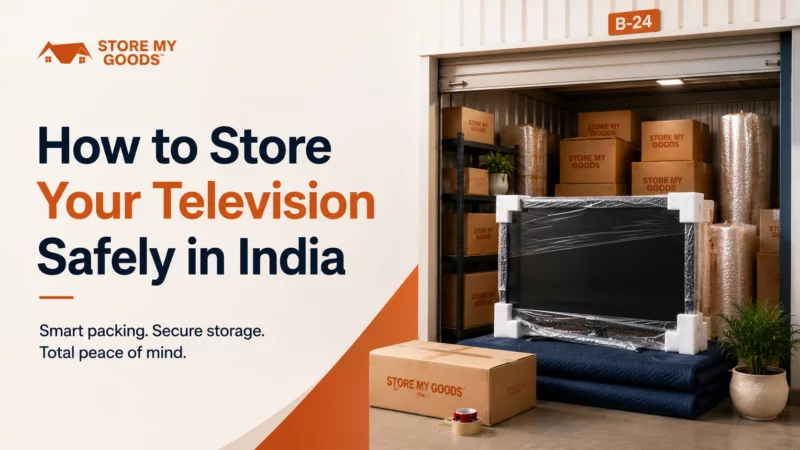
How to Store a TV Safely in India: Step-by-Step Guide for LED, OLED & QLED Screens
|
Quick answer: To store a television safely in India, disconnect and label all cables, clean with a microfibre cloth, wrap the screen with a soft blanket then bubble wrap (never plastic directly on the panel), stand upright in the original box or a double-walled carton with foam corner guards, and store in well suited space. Never lay a flat-screen TV on its side – the LCD or OLED panel bears uneven pressure and can permanently crack. In India’s peak summer heat (45°C+) and monsoon humidity, storing a TV in a non-AC room for more than a few weeks risks panel degradation and warranty void. |
A television is one of the most damage-sensitive items to store – not because it’s fragile in the everyday sense, but because the conditions it’s stored in matter enormously. From a 32-inch LED in a Delhi PG to a 77-inch OLED in a Mumbai apartment going through renovation, the risks are the same: heat, humidity, pressure, and vibration.
This guide covers the full packing sequence, panel-specific precautions, material dos and don’ts, and professional storage options for every budget – with pricing starting at ₹499/month via Store My Goods’ household storage across 75+ cities in India.
Why Safe TV Storage Matters in India – and What Goes Wrong Without It
Flat-screen televisions – whether LED, OLED, QLED, or QNED – share one critical vulnerability: their panels are not designed to bear mechanical stress outside a vertical position. A TV stored horizontally, even in its original box, places several kilograms of weight unevenly across an LCD layer or OLED substrate that is typically under 1mm thick.
Beyond physical pressure, India’s climate creates three additional risks during storage:
- Heat above 40°C: Warps plastic bezels, degrades OLED pixels, and can trigger LCD crystal settling in older panels. Summer temperatures in Delhi NCR, Rajasthan, and Maharashtra regularly exceed 45°C in non-air-conditioned spaces.
- Monsoon humidity (70–95% RH): Promotes moisture ingress into bezel seams, causing internal corrosion on PCB contacts and dead pixels on OLED panels. A non-sealed TV in a non-AC storage room during monsoon season can develop visible panel damage within 4–6 weeks.
- Dust accumulation: Fine particulate matter that settles inside unsealed vents causes overheating on first power-up. In industrial areas of Pune, Surat, or Ludhiana, a 3-month storage period can clog cooling vents enough to trip thermal protection circuits.
|
Warranty alert: Most TV manufacturers (Samsung, LG, Sony, Panasonic) specify storage conditions of 5–40°C and 20–80% relative humidity in their warranty documentation. Storage outside these conditions – including in an outdoor shed or a non-AC room during Indian summer – can void the warranty. Check your TV’s manual before choosing a storage location. |
How to Pack and Store a Television Safely in India (Step-by-Step)
1. Power down and disconnect: Switch off the TV from the remote and then at the wall. Unplug all cables – HDMI, power, antenna, optical audio. Coil each cable loosely (sharp coils stress the internal wiring) and label with a small sticky note before placing in a ziplock bag inside the box.
2. Clean the screen and body: Wipe the screen with a dry microfibre cloth – never use water, glass cleaner, or alcohol directly on the panel. Clean vents and ports with a soft dry brush. Any moisture left on the screen before boxing becomes a condensation source during temperature changes in storage.
3. Locate or create appropriate packaging: The original box with custom foam inserts is the best option – it is engineered for your specific model’s weight distribution. If unavailable, use a double-walled cardboard box with at least 5 cm of clearance on all sides. A box that is too large allows the TV to shift during transport, which is the most common cause of corner damage.
4. Wrap the screen properly: Place a clean soft blanket or fleece fabric against the screen first. Then wrap with anti-static bubble wrap (standard bubble wrap generates static discharge on sensitive OLED and QLED panels). Never apply cling film or standard bubble wrap directly on the screen – adhesive residue can permanently bond to the anti-reflective coating.
5. Protect the corners: Fit cardboard or foam corner guards on all four corners before boxing. TV corners bear the greatest mechanical stress during any impact. Without corner protection, a minor drop that wouldn’t crack the screen can still crack the bezel and break the backlight mounting brackets.
6. Add silica gel and pack upright: Place 3–5 silica gel packets inside the box before sealing to absorb residual moisture. Stand the TV upright in the box – never on its side, never flat. Fill remaining air gaps with crumpled paper or packing peanuts (not touching the screen). Seal with strong packing tape.
7. Label clearly and store properly: Write on all four sides of the box: ‘FRAGILE – This Side Up – Do Not Lay Flat – Electronics’. Store off the ground on a shelf or pallet, in a space maintained at 18–25°C. For storage beyond 4 weeks in India, a covered storage facility is the minimum requirement.
Panel-Type Storage Guide: LED, OLED, QLED & Plasma
The level of care required differs meaningfully between panel technologies. What works for an LED/LCD is not sufficient for an OLED.
| Panel Type | Storage Sensitivity | Key Precautions |
| LED/LCD | Moderate – most forgiving | Avoid temps above 45°C. Blanket + bubble wrap. Always upright. |
| QLED (Samsung, Hisense) | Moderate-High – quantum dot layer sensitive to sustained heat | Below 40°C mandatory. Silica gel inside box to protect quantum dot film. |
| OLED (LG, Sony, Philips) | High – most sensitive to heat, humidity, and pressure | 18–25°C, 40–60% RH only. Never non-AC storage. Never horizontal – even briefly. |
| QNED / MiniLED | Moderate – similar to QLED | Protect rear panel carefully – MiniLED backlight module is physically fragile. |
| Plasma (older models) | Low for temperature, high for humidity | Seal tightly against moisture. Heavy – always two-person lift, elevated storage. |
TV Storage Materials: What to Use and What to Avoid
| Material | Use or Avoid |
| Microfibre cloth | USE – only safe option for cleaning screen before boxing |
| Original foam inserts | USE – custom-fit for your model; always retain original packaging |
| Soft blanket / fleece fabric | USE as first screen layer before bubble wrap |
| Anti-static bubble wrap | USE for electronics – prevents static discharge on OLED and QLED panels |
| Silica gel packets (3–5 per box) | USE – absorb residual moisture; replace every 3 months for long-term storage |
| Foam corner guards | USE on all 4 corners – most vulnerable structural point |
| Plastic cling film directly on screen | AVOID – adhesive transfer to anti-reflective coating; cannot be removed without specialist solvents |
| Newspaper for padding | AVOID – ink transfer to screen and bezel; acidic paper yellows plastic |
| Standard bubble wrap directly on screen | AVOID – static discharge risk on OLED; use anti-static wrap instead |
| Glass cleaner or water on screen | AVOID – moisture ingress at bezel edge; damages oleophobic coating |
Where to Store a TV in India: Professional Storage vs. Home Options
The right storage option depends on how long you need to store, what conditions are available, and the value of the TV.
- In an AC bedroom or drawing room: Best for storage under 1 month during renovation. Keep the TV away from the work area – plaster dust is the most damaging substance to cooling vents.
- In a covered indoor storeroom (non-AC): Acceptable for storage under 2 weeks in non-summer months. In summer (April–June) or monsoon (June–September), temperatures and humidity in non-AC storerooms in Indian metros frequently exceed safe storage limits within days.
- In a self-storage or household storage facility: Self-storage facilities like Store My Goods maintain warehouses at 18–25°C with 40–60% RH, 24/7 CCTV, biometric access restrictions, and fire suppression systems. Best for any storage beyond 2–4 weeks in India.
Store My Goods’ household storage service includes doorstep pickup, professional three-layer packaging, and insurance coverage – starting from ₹499/month. Available across 75+ cities including Mumbai, Delhi NCR, Bangalore, Hyderabad, Pune, Chennai, Ahmedabad, and Coimbatore. No minimum lock-in – store for one month or one year, cancel with 48 hours’ notice.
- Standard plan from ₹499/month: Shared monitored facility. Doorstep pickup and packing included. Best for 1–2 TVs stored alongside other household items.
- Private plan from ₹100/sq ft/month: Dedicated lockable unit. Best for high-value TVs (OLED/QLED) or multiple large appliances stored together.
TV Storage Duration Guide: How Long is Safe?
| Storage Duration | What to Do |
| Under 1 month | Pack properly, store in AC room or covered indoor space. Silica gel inside box. No reconnection needed. |
| 1–3 months | Climate-controlled storage mandatory in Indian conditions. Power on once mid-storage if accessible. |
| 3–6 months (hostel, relocation gap) | Professional storage facility. Power on every 3 months for 30–60 mins. Refresh silica gel at 3-month mark. |
| 6–12 months (extended travel, renovation) | Professional storage facility only. Power on every 3 months. Label box with ‘Last powered on’ date. |
| 12+ months | Professional storage with quarterly check-ins strongly recommended. Some LCD crystals can settle unevenly beyond 18 months at ambient temperatures above 30°C. |
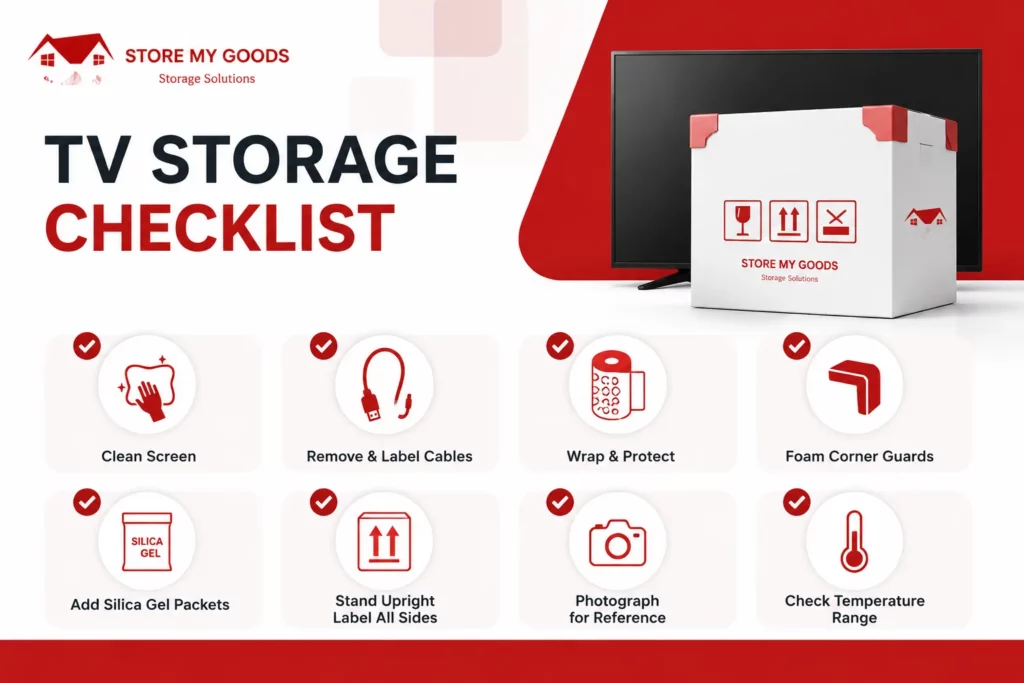
TV Storage Checklist – 8 Things to Do Before Handing Over to a Facility
• Clean screen with microfibre cloth – no water or glass cleaner
• Remove and label all cables – store in a separate labelled bag inside the box
• Wrap screen with soft blanket first, then anti-static bubble wrap – never cling film directly
• Fit foam corner guards on all 4 corners before boxing
• Add 3–5 silica gel packets inside the sealed box
• Stand upright in box – never flat. Label all sides: ‘Fragile – This Side Up – Do Not Lay Flat’
• Photograph the TV unpacked, packed, and boxed – for insurance reference
• Confirm the storage facility’s temperature range – must be 18–40°C maximum for LED; 18–25°C for OLED
Frequently Asked Questions About Storing Televisions in India
Q. How should I store my TV when moving or renovating in India?
Disconnect and label all cables. Clean with a microfibre cloth. Wrap the screen with a soft blanket then anti-static bubble wrap. Stand upright in the original box or a double-walled carton with foam corner guards. Mark the box ‘Fragile – This Side Up’. Store My Goods provides professional TV and household storage across 75+ cities from ₹499/month with doorstep pickup and packaging included.
Q. Can I store a flat-screen TV lying flat or on its side?
No. Never lay a flat-screen TV horizontally or on its side for storage. The panel bears its own weight only vertically. Horizontal storage puts uneven pressure on the LCD or OLED layers, causing permanent pixel damage or panel cracking – even in the original box.
Q. What temperature should I store my TV at in India?
Store between 5°C and 40°C with 20–80% relative humidity (non-condensing). Ideal is 18–25°C at 40–60% RH. Indian summer regularly exceeds 45°C in non-AC spaces – risking bezel warping, OLED degradation, and warranty void..
Q. How long can I safely store a flat-screen TV?
In a storage facility, a properly packed TV can be stored for 1–3 years without degradation. For storage beyond 6 months, power it on every 3 months for 30–60 minutes to prevent capacitor degradation and evaporate any residual internal moisture. Use 3–5 silica gel packets inside the box and replace at 3-month intervals.
Q. What happens to an OLED TV stored in Indian heat or monsoon humidity?
OLED panels are far more sensitive than LED/LCD to heat and humidity. Temperatures above 40°C accelerate pixel degradation. Humidity above 80% RH risks moisture ingress into the panel layers, causing dark patches or dead pixels within weeks. OLED TVs must only be stored in climate-controlled environments – not in outdoor sheds, vehicle cargo holds, or non-AC storerooms during Indian summer or monsoon.
Q. How much does professional TV storage cost in India?
Store My Goods’ household storage starts from ₹499/month for a standard shared plan, including doorstep pickup, three-layer packing, and insurance coverage. Private storage (dedicated lockable unit) starts from ₹100/sq ft/month. Available across 75+ cities with no minimum lock-in – cancel with 48 hours’ notice.
Final Thought
Storing a television safely in India requires more than wrapping it in newspaper and hoping for the best. The panel type, storage duration, and packing materials all determine whether your TV survives intact. A properly packed TV in a self-storage facility will be ready to use the moment you need it. A TV stored in a non-AC room through a Mumbai monsoon may not be.
Explore household storage solutions from ₹499/month or book doorstep pickup.



 A-23, A-Block, Sector 83, Noida Pin Code - 201305
 +91 9311806600
 contact@storemygoods.in
 Hours: 9:30AM - 8:00PM
No Comment