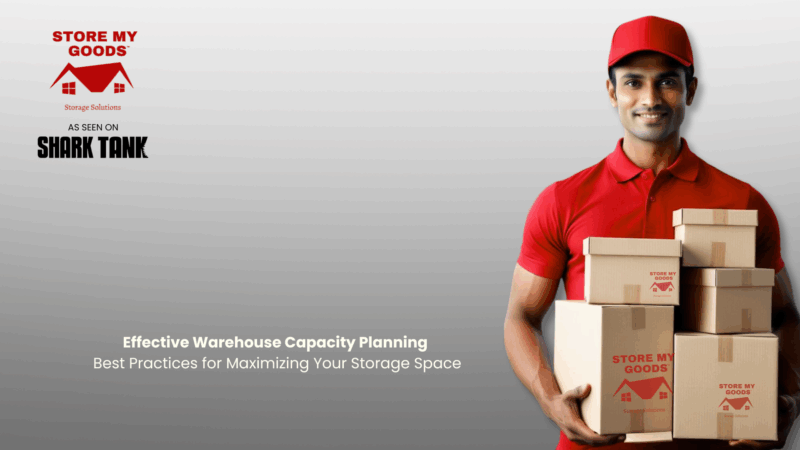
Effective Warehouse Capacity Planning – Best Practices for Maximizing Your Storage Space
|
Quick answer: Most warehouses only use 22–27% of their true cubic capacity – the rest is lost to poor layout, wide aisles, and low-density racking. Before leasing more space, fix utilization first: measure actual vs. usable space, adopt smart racking, and offload seasonal overflow instead of overbuilding. Store My Goods offers pay-as-you-store overflow space from ₹100/sq. ft., so peak-season inventory doesn’t force a bigger permanent lease. See the full best-practices checklist below, or get a warehouse storage quote in under 2 minutes. |
In logistics, space is profit. Poor warehouse capacity planning leads to inefficiencies, slower fulfillment, and rising costs. As India’s e-commerce and manufacturing sectors grow, optimizing warehouse space has become crucial to business performance.
Most warehouses only reach 22–27% cube utilization according to NetSuite’s warehouse space utilization benchmarks, with 80–85% considered good for standard operations – the gap between those two numbers is where most of the cost savings below live. Whether you’re managing a small distribution center or a large fulfillment hub, these six practices will help you maximize storage space and drive bottom-line results.
Best Practices for Warehouse Capacity Planning
1. Measure Actual vs. Usable Space
Don’t just calculate floor area – measure height, layout, and obstructions to know your true cubic capacity. Industry benchmarks put typical cube utilization at 22–27%, so most warehouses have meaningfully more usable space than their floor-area number suggests.
2. Optimize Layout for Flow
Design your warehouse for seamless movement – from inbound docks to outbound shipments. Use cross-docking methods to minimize double handling and delays.
3. Adopt Smart Racking Systems
Adjustable pallet racks, narrow-aisle shelving, and mezzanine levels increase space utilization significantly.
4. Integrate Technology
Use warehouse management systems (WMS) for real-time inventory, forecasting, and slot optimization. Automation minimizes human error and boosts order accuracy.
5. Plan for Seasonal Peaks
India’s festive and e-commerce surges can double demand. Use Store My Goods’ pay-as-you-store overflow space – from ₹100/sq. ft./month, no lock-in – for seasonal inventory instead of leasing permanent space you’ll only need for a few months a year. See business storage plans or read how other businesses cut warehousing costs this way.
6. Prioritize Safety and Accessibility
An efficient warehouse must also be safe. Maintain clear aisles, safety markings, and easy access to emergency exits to comply with ISO and labour safety standards – see the FAQs page for how Store My Goods facilities handle compliance.
How Much Does Overflow Warehouse Storage Cost?
Store My Goods prices warehouse and business storage on a simple, transparent structure with no lock-in:
● Private, dedicated space – starting from ₹100/sq. ft./month, suited to seasonal overflow inventory that needs its own locked, single-tenant area.
● Business/bulk storage – custom pricing quoted per pallet or per square foot for larger warehouse overflow, with GST-compliant billing and a dedicated account manager included.
Both plans include doorstep pickup, CCTV monitoring, and month-to-month billing with no lock-in – scale up before a festive-season surge and scale back down once it passes. Exact rates vary slightly by city – view live pricing for Mumbai as a reference, or get a warehouse storage quote for your city in under 2 minutes.
Overcoming Common Challenges
● Regulatory Compliance: factor in fire codes (e.g., sprinkler clearances) during planning to avoid costly redesigns.
● Seasonal Fluctuations: build buffer zones or partner with an offsite storage provider for overflow.
● Labor Shortages: automation mitigates the impact, but train staff on new systems.
|
“The most common mistake we see is businesses renting a bigger warehouse before they’ve actually measured what they’re using. When we walk a client’s floor, we typically find they’re storing at 20% cube utilization in a space sized for 40%. Before you sign a bigger lease, run the numbers: measure your actual stacked volume against total cubic capacity, not just floor area. Most businesses that do this find 6–8 months of headroom they didn’t know they had — and offloading seasonal overflow instead of overbuilding typically cuts annual storage spend by 30–35%.”
– Arjun Mehta, Storage Operations Head, Store My Goods |
Why Businesses Trust Store My Goods for Warehouse Overflow
● 7M+ items stored, with a 99.2% secure-delivery record.
● CCTV-monitored, fire-detection-equipped warehouses across 75+ Indian cities.
● Comprehensive risk coverage included on every item from the moment of pickup.
● 4.8★ rating from 10,000+ customers, and featured on Shark Tank India.
● No lock-in – scale overflow space up for a peak season and back down once it passes.
Explore Warehouse Storage or Business Storage plans, check coverage in Mumbai, Bengaluru, and Pune.
Frequently Asked Questions About Warehouse Capacity Planning
How much does overflow warehouse storage cost in India?
Store My Goods’ private, dedicated warehouse space starts from ₹100/sq. ft./month, with no lock-in. Larger overflow needs are custom-quoted per pallet or square foot, with GST-compliant billing and a dedicated account manager.
What is a good warehouse space or cube utilization rate?
Industry benchmarks put typical warehouse cube utilization at 22–27%, with 80–85% considered good for standard operations. 100% utilization is not the goal – it leaves no room for staging, picking, or handling, which slows fulfillment.
Can we store inventory short-term during a seasonal peak only?
Yes. Store My Goods bills month-to-month with no lock-in, so you can scale up storage for a festive-season or e-commerce surge and scale back down once demand normalizes, without committing to a year-long lease.
Does Store My Goods offer warehouse management or just storage space?
Store My Goods provides secure, CCTV-monitored storage space with digital inventory tracking and doorstep pickup. It complements a warehouse management system (WMS) rather than replacing one – you keep visibility into what’s stored offsite alongside your in-house inventory.
How is climate and pest control handled for warehouse-stored inventory?
Store My Goods facilities are climate-monitored and run dedicated pest-control protocols, in addition to CCTV surveillance and fire-detection systems, so inventory moved offsite isn’t exposed to worse conditions than your primary warehouse.
Is there a minimum warehouse storage commitment?
No. Billing is month-to-month with no minimum lock-in beyond one month, which is why it works for seasonal overflow as well as longer-term capacity needs.
Can we track our stored inventory remotely?
Yes. Every item is catalogued digitally at pickup, and a live inventory portal lets you check what’s stored and request specific items back without a site visit.
Which cities does Store My Goods offer warehouse and business storage in?
Store My Goods operates in 75+ Indian cities, with core hubs in Mumbai, Delhi NCR, Bengaluru, Hyderabad, and Pune, extending to Chennai, Ahmedabad, Coimbatore, Lucknow, and more.
Conclusion
Efficient capacity planning transforms warehouses into productivity hubs. Optimize your space, reduce costs, and improve fulfillment with Store My Goods, your trusted partner for professional warehouse and logistics storage solutions across India. Explore Warehouse Storage plans or get a quote in under 2 minutes.


 A-23, A-Block, Sector 83, Noida Pin Code - 201305
 +91 9311806600
 contact@storemygoods.in
 Hours: 9:30AM - 8:00PM
No Comment