
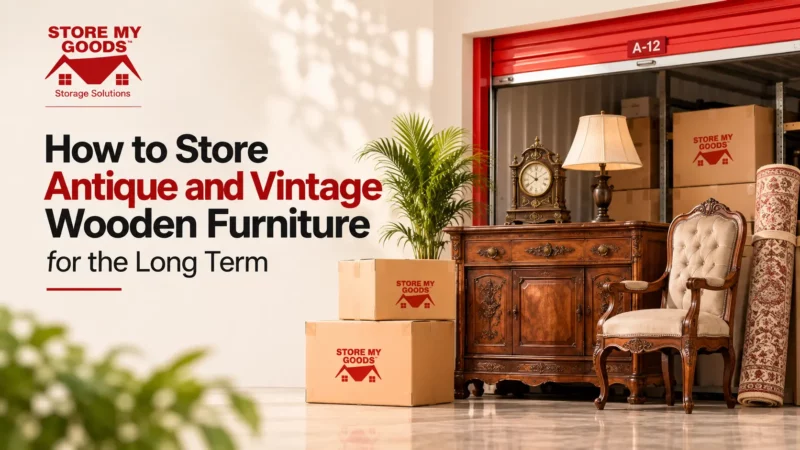
How to Store Antique and Vintage Wooden Furniture for the Long Term
|
Quick Answer: To store antique (100+ years) and vintage (20–99 years) wooden furniture for years without damage, use a secure, climate-controlled indoor storage facility (or an equally dry, ventilated room) with 24/7 surveillance and pest control. Wrap pieces in breathable cotton (never plastic), keep them elevated off the floor, stack nothing on top, and maintain an itemised inventory. |
Whether you are safeguarding a century-old Burma teak almirah during a home renovation, relocating abroad on a multi-year assignment, or managing an inherited family collection, the guide below walks through how to prepare your pieces, where to store them safely, and how managed warehousing solves the risks of leaving heirloom wood unattended.
At a Glance: 6 Rules for Long-Term Antique Wood Storage
- Do not restore or re-polish before storage. Dust gently, photograph every angle, and preserve the original patina.
- Disassemble only what is built to come apart. Remove screw-in legs, shelves, drawers, and glass; label every hardware bag.
- Wrap in breathable layers only. Use cotton sheets and moving blankets-never cling film, shrink wrap, or bubble wrap directly on wood.
- Elevate and space every piece. Keep furniture raised off concrete floors with air circulation on all sides and zero stacking.
- Prioritise environmental stability over a locked flat. A dry, ventilated, pest-managed warehouse protects wood far better than an unmonitored apartment or garage.
- Use QR-tagged tracking and periodic checks. Maintain dated arrival photos and review condition before and after every monsoon.
Why Antique Wooden Furniture Fails in Storage (When Modern Furniture Survives)
Furniture crafted decades or centuries ago was built from seasoned solid timber-teak, rosewood, sheesham, or mahogany – joined with hide glue and hand-cut mortise-and-tenon joints, and finished in shellac, French polish, or natural wax. Unlike modern engineered boards and synthetic adhesives, old solid wood is hygroscopic: it absorbs moisture and swells when humidity rises, then releases moisture and shrinks when the air dries out.
When stored in an environment with sharp seasonal swings, five slow failures occur:
- Splits and cupping: A solid tabletop that swells during July monsoon humidity and shrinks in a dry winter cracks along the grain.
- Open joints: Traditional hide glue softens and lets go under repeated moisture cycles, leaving chairs wobbly and drawers jammed.
- Lifting veneer and inlay: Thin decorative veneers, brass inlay, and marquetry expand at a different rate from the core timber beneath them.
- Mould bloom and cloudy polish: Sustained humidity above 70% triggers fungal bloom and turns shellac finishes milky or sticky.
- Wood borers and termites: Dark, unventilated corners with damp air attract powderpost beetles and termites that tunnel silently through pale sapwood.
Which Situation Are You In? Tailoring Your Storage Plan
Different life transitions create different risks for heirloom wood. Match your situation below:
1. Homeowners Renovating or Remodelling (2 to 6 Months)
Construction dust is abrasive, but trapped moisture is worse. Fresh plaster, wall putty, screed, and paint release litres of water into indoor air for weeks-meaning an antique four-poster bed kept “safely” in a spare bedroom during civil work often emerges with a cloudy finish and swollen drawers. Move delicate pieces off-site before demolition begins, and bring them back room by room only after walls are completely dry and floor polishing has cured. With Store My Goods, you can store an entire room’s furniture during renovation and recall pieces in phases as each room finishes.
2. Relocating Expats, Diplomats, and Corporate Transferees (12 to 36 Months)
Shipping heavy solid-wood antiques overseas is expensive and exposes them to weeks of extreme heat inside ocean freight containers. Leaving them inside a locked apartment is equally risky: with windows shut and no airflow, summer indoor temperatures soar and monsoon dampness sets in unnoticed. When you store with Store My Goods, every piece is individually QR-tagged on pickup and logged into your online Self-Care Portal with dated condition photos-so you can monitor your inventory from anywhere in the world, or authorise a family member in India to request a single item on your behalf.
3. Downsizers and Urban Movers
A 7-foot colonial wardrobe or 10-seater dining table that fit effortlessly into an ancestral bungalow often will not clear a modern apartment lift or stairwell. Rather than selling irreplaceable timber at a discount, keep what fits your new layout and move oversized pieces into managed storage. Using a single provider that handles disassembly, breathable wrapping, transport, and warehousing eliminates the double-handling where corners get chipped.
4. Private Collectors Managing Overflow
Auction acquisitions often arrive faster than gallery or living space. Maintain a catalogue with lot numbers, provenance, and declared values, and separate solid timber from delicate veneered, gilded, or lacquered pieces. Because Store My Goods assigns a unique QR barcode to every stored item rather than burying items in bulk piles, collectors can rotate pieces in and out-recalling a single console or armchair with 48 hours’ notice without disturbing the rest of their collection.
Where to Store Antique Wooden Furniture: Comparing Your Options
When searching for a furniture warehouse near you or comparing furniture storage rental options, evaluate every space on environmental stability, pest protection, and item-level accountability:
| Storage Option | Humidity & Heat Stability | Pest & Security Protection | Key Risks for Antique Wood |
| Spare Room at Home | Moderate (if an interior room away from outer walls) | Low security monitoring if house is empty | Dust, roof seepage, and zero airflow if windows stay shut |
| Garage, Basement, or Terrace Room | Poor-tracks outdoor heat and monsoon dampness | High risk of termites, rodents, and water ingress | Concrete floor dampness and extreme temperature swings |
| Locked Flat While Abroad | Poor-trapped summer heat and 75%+ monsoon humidity | Unmonitored for months at a time | Silent wood-borer infestations and mould go undetected |
| Metal Shipping Containers / Furniture Storage Pods | Poor-steel walls bake by day and sweat condensation at night | Moderate security, poor ventilation | Condensation drips directly onto wood finishes during rains |
| Traditional Unorganised Warehouse | Unpredictable; often dusty and overcrowded | Basic locks, inconsistent pest control | Heavy items stacked on top of antiques; no item tracking |
| Store My Goods Managed Warehouse | High stability: dry, indoor, ventilated, elevated off floors | 24/7 CCTV, restricted staff-only access, scheduled pest control | Requires advance booking for pickup and 48-hour recall notice |
Storing Antique Furniture in Humid Cities: Mumbai, Bangalore, and Delhi-NCR
India’s regional climates test wooden furniture in very different ways:
- Mumbai & Coastal Cities: Salt-laden sea breeze and peak-monsoon humidity exceeding 80% make fungal bloom, swollen drawers, and veneer lifting the top threats. Keeping timber elevated off concrete floors in a dry, pest-treated indoor facility is critical. Explore our dedicated furniture storage in Mumbai service for doorstep packing and warehouse protection.
- Bangalore & Pune: While temperatures are milder, high corporate mobility and frequent apartment renovations mean thousands of households seek furniture storage in Bangalore every month. Sudden post-rain humidity spikes still affect unsealed teak and rosewood kept in ground-floor rooms.
- Delhi-NCR & North India: Extreme swings between 45°C dry summers, 80% July monsoons, and dry winters cause solid wood panels to expand and contract aggressively. Indoor, ventilated warehousing shields timber from direct thermal extremes.
What Does Antique Furniture Storage Cost in India?
When comparing furniture storage prices, remember that safe antique care is priced around volume, protection, and duration rather than a flat rate. Five variables determine your monthly quote:
| Pricing Factor | How It Affects Your Quote | How to Optimise Cost |
| Item Volume (Cubic Feet / Sq Ft) | A 3-door teak wardrobe occupies more warehouse footprint than two accent chairs. | Disassemble detachable legs, frames, and tops safely. |
| Storage Duration | Longer commitments (6, 12, or 24+ months) unlock lower monthly rental tiers. | Ask your account manager about multi-month tenure plans. |
| Plan Type (Per-Item vs. Private Room) | Pay-per-item fits 1 to 10 pieces; dedicated private space suits a full villa or collector’s lot. | Pay only for the exact items stored instead of empty air space. |
| Packing & Handling | Multi-layer breathable wrapping, dismantling, and custom crating require specialist materials. | Combine packing, transport, and storage in one bundled quote. |
| City & Pickup Logistics | Warehouse real estate and transport distance vary between metro hubs like Mumbai, Bangalore, and Delhi. | Schedule pickup from the city where the furniture is currently located. |
Store My Goods Pricing Reference:
- Pay-Per-Item Furniture Storage: Starts from ₹499/month for individual items, scaling transparently based on item dimensions and volume.
- Private Storage Units / Household Plans: Starts from ₹100/sq ft (or bundled household tiers for 1BHK, 2BHK, and 3BHK volumes in cities like Mumbai and Bangalore), giving you flexible monthly furniture storage for rent with no rigid lock-in.
Note: Final pricing depends on item volume, city, wrapping requirements, and storage tenure.
How Store My Goods Protects Your Antique & Vintage Furniture End-to-End
Instead of juggling separate packers, transporters, and unverified godowns, Store My Goods manages the entire lifecycle of your heirloom furniture under one roof:
- Doorstep Assessment & Multi-Layer Breathable Wrapping: Our trained crew visits your home, carefully disassembles detachable components, labels all hardware, and wraps every wooden surface in protective, breathable padding and moving blankets to prevent scratches and trapped moisture.
- Individual QR Tagging & Digital Photo Inventory: Before leaving your doorstep and upon warehouse check-in, each piece is photographed and assigned a unique QR code. You can view your complete itemised inventory anytime inside your Store My Goods Self-Care Portal.
- Controlled, Dry, Pest-Managed Indoor Warehousing: Your furniture is stored inside clean, dry, well-ventilated indoor warehouses-elevated off the floor on pallets, spaced for healthy airflow, never stacked under heavy boxes, and protected by scheduled pest and rodent control.
- 24/7 Surveillance & Restricted Access: Facilities are monitored round the clock with CCTV (with 30-day footage retention), fire-safety systems, and strict access restricted exclusively to authorised warehouse personnel.
- 48-Hour On-Demand Recall & Reassembly: Need your dining table back for Diwali or your study desk delivered to a new flat? Select the specific QR-tagged item in your portal, and our team will deliver and reassemble it within 48 hours without disturbing your remaining items.
- Pan-India Reach Across 75+ Cities: Available across Mumbai, Bangalore, Delhi, Gurgaon, Noida, Hyderabad, Pune, Chennai, Kolkata, Ahmedabad, and 65+ additional cities.
Ready to protect your heirloom pieces? Speak with a Store My Goods storage specialist for a transparent, itemised quote at storemygoods.com/furniture-storage or call 18004089868 (9:30 AM – 6:30 PM).
Frequently Asked Questions
Q: How long can antique wooden furniture stay in storage?
Antique and vintage wooden furniture can remain in storage for several years-commonly 12 to 36 months for expat postings or estate settlements-provided it is kept in a dry, ventilated indoor warehouse, elevated off the floor, and wrapped in breathable materials rather than sealed plastic.
Q: How does Store My Goods track individual antique furniture pieces?
Every piece of furniture is photographed upon pickup/arrival and labelled with a unique QR barcode linked to your online Self-Care Portal. This creates an item-level digital record and lets you request delivery of a single piece within 48 hours without disturbing the rest of your stored items.
Q: Should I wrap antique wood in plastic or bubble wrap for long-term storage?
No. Plastic wrap and bubble wrap placed directly against wood trap condensation, which can cloud shellac finishes and trigger mould growth. Always use clean cotton sheets and breathable moving blankets, reserving plastic strictly as a temporary outer rain cover during transit.
Q: Can I leave antique furniture in my locked flat while I am abroad?
Leaving wooden antiques in a closed apartment is risky because zero airflow, high summer heat, and 75%+ monsoon humidity cause warping, mould, and undetected wood-borer damage. A managed, pest-controlled indoor warehouse provides far better protection and accountability.
Q: How much does antique furniture storage cost in India?
At Store My Goods, pay-per-item furniture storage starts from ₹499 per month, while dedicated private storage units start from ₹100 per sq ft. Final monthly rental depends on total item volume, city (such as Mumbai, Bangalore, or Delhi), wrapping needs, and storage duration.
Q: Should I polish or restore antique furniture before putting it into storage?
Dust it gently with a dry microfibre cloth, but avoid sanding, varnishing, or oiling before storage. Fresh oils attract dust, and refinishing can strip valuable historical patina. Complete any restoration work after the piece returns to its permanent home.

 A-23, A-Block, Sector 83, Noida Pin Code - 201305
 +91 9311806600
 contact@storemygoods.in
 Hours: 9:30AM - 8:00PM
No Comment